

Ensuring your ATV is equipped with the best possible parts involves giving special attention to its battery. Continuous riding enjoyment and the ability to perform specific tasks hinge on having a battery that not only lasts but also thrives in adverse conditions. Recognizing the importance of maintenance and being prepared can significantly reduce battery-related setbacks. With a bit of knowledge and regular upkeep, you can extend the life of your ATV battery, keeping those wheels rolling and adventures ongoing.

What Kind of Battery Does an ATV Use?
All-terrain vehicles (ATVs) rely on powersport batteries, akin to those employed in motorcycles, jet skis, snowmobiles, and other leisure vehicles. ATV enthusiasts can choose from three distinct battery types: flooded lead acid, absorbed glass mat (AGM), and lithium iron phosphate. Each offers unique advantages and characteristics.Flooded Lead Acid Battery: These conventional batteries typically serve an ATV for about 2 to 3 years, extending up to 4 to 5 years with meticulous maintenance and ideal usage conditions. They are less adept at coping with environmental stresses compared to their sealed counterparts, leading to a shorter lifespan. A notable characteristic is their higher self-discharge rate, losing around 13% of their charge monthly.
- Most affordable among the trio
- Shortest service life
- Requires regular electrolyte top-ups with distilled or deionized water
- Prone to faster self-discharge when not in use
- Comes with a 6-month warranty
AGM Battery: Standing as the prevalent choice for modern ATVs, AGM batteries boast longevity exceeding that of traditional flooded types. Their lifespan ranges from 3 to 5 years, potentially reaching 6 to 8 years with proper care. Unlike flooded batteries, AGMs degrade gradually, necessitating more frequent charges over time until replacement is needed. These batteries are notable for their minimal discharge rate, with a monthly loss of just 1-3% of their charge.
- Costs slightly more than flooded batteries
- Offers a lifespan 2-3 times longer
- Maintenance-free and fully sealed
- Lower discharge rate compared to flooded types
- Quicker charging capabilities
- Withstands vibrations and extreme temperatures well
- Warranty period spans 12-24 months
Lithium Iron Phosphate Battery: Although not as commonly used in ATVs as AGM and lead-acid batteries due to their higher price and reduced efficiency in cold conditions, lithium iron phosphate batteries excel in longevity and performance. They can endure between 2,000 to 5,000 charge cycles under optimal conditions, significantly outpacing lead-acid batteries which range from 500 to 1,000 cycles. These batteries also feature the lowest monthly self-discharge rate of 1%.
- Highest priced option
- Can last 3-4 times longer than flooded batteries, with up to 2000 cycles
- Maintenance-free and fully sealed
- Exhibits the lowest rate of self-discharge
- Fastest to charge
- Vibration and extreme heat resistant
- Lightweight with consistent power output
- Comes with a 36-month warranty
The lifespan of ATV batteries varies by type: flooded lead acid batteries average 2 to 3 years, AGM batteries 3 to 5 years, and lithium iron phosphate batteries can last 8 to 10 years, outperforming others. However, longevity is influenced by factors such as storage conditions, maintenance practices, and climate, affecting the overall life expectancy of ATV batteries.
|
Battery Type |
Average Lifespan |
Cost |
Maintenance |
Discharge Rate |
Charging Speed |
Resilience |
|
Flooded |
2-3 years |
Least expensive |
Requires electrolyte top-off |
High (13% per month) |
Standard |
Sensitive to
environmental
conditions
|
| AGM |
3-5 years,up to 6-8 |
More expensive
than flooded
|
Maintenance-free |
Low (1-3% per
month)
|
Faster than flooded |
Resistant to
vibrations and
extreme
temperatures
|
|
Lithium lron
Phosphate
|
Up to 8-10 years |
Most expensive |
Maintenance-free |
Very low (1% per
month)
|
Fastest |
Resistant to
vibrations and
extreme heat,
lightweight
|
What should you consider when buying a new ATV battery
When venturing into the market for a new ATV battery, several crucial metrics should guide your selection, ensuring you get a battery that not only meets your power needs but also withstands the elements and lasts through many adventures.Cranking Amps (CA): This figure represents the battery's ability to start an engine in temperatures of 32 degrees Fahrenheit and above. A higher CA value indicates a stronger starting power under warmer conditions.
Cold Cranking Amps (CCA): This measures the battery's starting power at freezing temperatures, specifically 0 degrees Fahrenheit. A robust CCA rating is essential for riders in colder climates, with a minimum of 300 CCA recommended, though 500 CCA is preferred for optimal cold-weather performance.
Amp Hours (AH): AH signifies the battery's endurance, indicating how long it can sustain a specific electrical output. A higher AH rating is crucial for extended rides, as it reflects the battery's capacity to power your ATV over time.
Reserve Capacity (RC): This metric offers insight into how long your battery can operate essential features under a constant load before dipping below 10.5 volts, usually measured at a 25-amp discharge rate at 80 degrees Fahrenheit. A higher RC value means more runtime and reliability for your ATV's electrical demands.
Cycle Life: The cycle life of a battery sheds light on its longevity, counting the number of charge and discharge cycles it can undergo before performance degrades. A battery with a high cycle life promises a longer service period before needing replacement.
|
Specification |
Description |
|
Cranking Amps (CA) |
Measures the battery's ability to start an engine in temperatures of 32'F and above.Higher values indicate stronger starting power. |
|
Cold Cranking Amps (CCA) |
Indicates the battery's starting power at O°F. Essential for cold climates, with 300 CCA as minimum recommmended,and 500 CCA preferred for optimal performance. |
|
Amp Hours (AH) |
Reflects how long the battery can sustain a specific electrical output. A higher AH rating means longer ride durations. |
|
Reserve Capacity (RC) |
Shows how long the battery can operate essential features under a constant load before dropping below 10.5 volts, typically at a 25-amp discharge rate at 80°F. A higher value means more runtime. |
|
Cycle Life |
The number of charge and discharge cycles a battery can undergo before performance degrades. A higher number indicates a longer lifespan. |
Can i jump an ATV starter battery with a car
Yes, but it requires caution. Here's a detailed process:First, ensure both the car and the ATV are turned off.
Connect the positive (red) jumper cable to the positive terminal of the ATV battery, then to the positive terminal of the car battery.
Then, connect the negative (black) cable to the car battery's negative terminal, and attach the other end to a metal part of the ATV's frame, away from the battery.
Once connections are secure, start the car, let it idle, then start the ATV.
After the ATV starts, first remove the negative cable from the ATV, then from the car, followed by the positive cable in the same order.
Why does my ATV battery keep dying
Several factors can contribute to a dying ATV cranking battery:Parasitic Drains: These are small but continuous draws on the battery, like a clock or security system, which can drain the battery over time.
Age and Usage: Batteries degrade with age and use. An older battery may not hold a charge as well as a new one.
Infrequent Use: If you're not using your ATV regularly, the battery will slowly discharge.
How many volts is an ATV battery?
ATV batteries are commonly marked with a 12V label, yet upon measurement, they typically display readings in the range of 12.6V to 13.1V. This variation in voltage can be attributed to differences in battery types and specific models.The reason behind these batteries showing values above the 12V mark is to ensure they remain on the preferable side of the 12V spectrum. A reading below 12V, specifically around 11.8V, signals a potential issue, indicating either the death of a battery cell or the onset of sulfation within the battery, necessitating its replacement.
Should a battery exhibit a voltage exceeding 13.1V, it could be an indication of an overcharging issue, often pointing towards a malfunctioning alternator.
In the case of ATVs designed for toddlers, a 6V battery is the standard, fitting the lesser power requirements and the compact size of these vehicles. The idea of equipping an adult ATV with two 6V batteries, although technically possible, is advised against. The rationale is the significant increase in weight compared to a single 12V battery, which could adversely affect the ATV's balance and performance.
How to check ATV battery voltage?
To properly assess the voltage of your ATV's battery, follow these steps with the vehicle turned off. Begin by taking off the terminal covers. Examine the terminals for any signs of corrosion, and clean it off if present. Use a digital voltmeter, connecting its positive lead to the battery's positive terminal and the negative lead to the negative terminal. The voltmeter will display a reading; take note of this value. Afterward, disconnect the voltmeter and put the terminal covers back on.
Consult your ATV's manual or the battery itself to determine the optimal voltage range. Typically, batteries perform best when they register between 12.6 to 12.8 volts. Anything below 12.6 volts suggests the battery might be undercharged; consider recharging it to see if the voltage increases. If recharging doesn't help, the battery may be experiencing sulfation. Minor sulfation can sometimes be remedied, allowing continued use of the battery. However, if sulfation has significantly lowered the battery's voltage to below 11.8 volts, or if it cannot be cleaned off, purchasing a new battery becomes necessary.
Should the battery exhibit an unusually high voltage, try using the ATV's high beams to drain some power. If the voltage remains excessively high, the issue might lie with the alternator and warrants further inspection.
For those with AGM (Absorbent Glass Mat) batteries, note that these typically require a slightly higher voltage range of 12.8 to 13.1 volts, owing to their unique construction which does not necessitate liquid maintenance. If you encounter any problems with the voltage of an AGM battery, it's advisable to seek the expertise of a mechanic.
|
Step |
Instruction |
| 1 |
Make sure your ATV is turned off |
| 2 |
Remove the terminal covers. |
| 3 |
Check the terminals for corrosion and remove any corrosion |
| 4 |
Attach the positive end of a digital voltmeter to the positive terminal on the battery and the negative end to the negative terminal. |
| 5 |
Read the number on the voltmeter. |
| 6 |
Remove the digital voltmeter and replace the terminal covers. |
How to charge a ATV battery without a charger
If you're without a traditional charger, consider these alternatives:
Solar Panels: These are excellent for outdoor charging situations. They convert sunlight into electrical energy and can be connected directly to the battery.USB Converters: Use these to convert power from a USB port into a suitable charging current for your ATV battery. Ideal for emergency situations or when you're on the go.
These methods are less efficient than standard chargers, so monitoring the charging process is essential.Can a typical car alternator safely charge an ATV battery?
It's generally not recommended to use a car alternator to charge an ATV battery due to the risk of overcharging and potential damage. Car alternators are designed to charge larger car batteries and may provide too much current for an ATV battery.Is it possible to use an ATV battery in a 12V kids ride on toy?
Yes, it's possible, but with several considerations:Ensure the voltage matches (most kids' ride-on toys use 12V batteries).
Check the physical dimensions and weight of the ATV battery to ensure it fits safely in the toy vehicle.
Be aware of the increased weight and power, which might affect the toy's performance and safety.
How to Maintain an ATV Battery
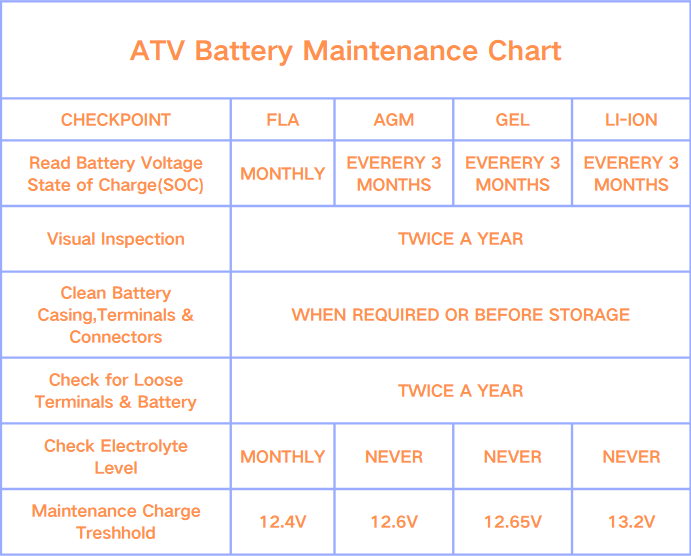
Maintaining your ATV battery is crucial for its longevity and performance, regardless of the battery type. Proper care can significantly extend its life, especially during periods of inactivity or storage. Here's a consolidated guide with essential tips for ATV battery care and maintenance:
Charge Regularly: It's vital to keep your ATV battery charged. Use a suitable charger that matches the battery's voltage and chemistry. For lithium batteries, which have a low self-discharge rate, maintain about a 50% charge during long storage periods. Avoid overcharging by using a maintainer or a charger with an automatic shut-off feature.
Proper Storage: Store your ATV and its battery in a climate-controlled environment to prevent damage from extreme temperatures. If storing for more than a month, consider removing the battery from the vehicle. Ideally, room temperature should be maintained at or above 32°F to avoid cracking the battery casing or bending its plates.
Battery Maintenance: For flooded batteries, periodically top off the electrolyte with distilled or deionized water. Keep the battery clean from dirt and debris using a damp cloth or sponge, avoiding high-pressure water or corrosive agents. Check the battery's voltage regularly with a multimeter; a fully charged battery should show 12.8 volts or higher.
Terminals and Connections: Ensure the battery is installed correctly with secure connections. Regularly inspect and clean battery terminals and cable connections to prevent corrosion, using a terminal brush and a baking soda-water mixture. Protect terminals with anti-corrosion spray.
Ventilation and Electrolyte Levels: Ensure adequate ventilation during charging to disperse hazardous gases. For conventional lead-acid batteries, maintain proper electrolyte levels and inspect the exhaust tube for any obstructions.
Smart Charging and Maintenance Charging: Use a quality battery charger for regular maintenance and a maintenance charger or tender during extended storage to prevent self-discharge and sulfation. Consider placing AGM batteries on a low-amp charge for longevity.
Routine Use: To prevent your battery from remaining unused for too long, run your ATV every two weeks for about 15-20 minutes, if possible, to keep the battery in good condition.
When to Replace: Despite your best efforts in maintenance, batteries will eventually need replacement. If your battery struggles to hold a charge or is over three years old, it may be time for a new one.
How to prevent ATV battery depletion in cold climates
Cold weather can severely impact battery performance. To mitigate this:Keep the battery on a tender or trickle charger, which supplies a small, steady amount of power to keep the battery fully charged.
Regularly starting the ATV and letting it run for a few minutes can also help maintain battery health.
An informed approach to your ATV's battery care can vastly enhance your riding experience. Understanding the types of batteries, how to maintain them, and troubleshooting common issues ensures your adventures are powered effectively and safely.
FAQs about ATV Batteries
Do all ATVs use the same battery?
Most ATVs are powered by 12-volt batteries, which generally fall into one of three categories: conventional flooded, AGM (Absorbent Glass Mat), and lithium batteries. While conventional flooded batteries typically demand more upkeep, AGM and lithium variants are known for requiring less maintenance.How many cranking amps should an ATV battery have?
CCA, standing for Cold Cranking Amps, measures the amount of current a battery can deliver at 0 degrees Fahrenheit. The higher the CCA rating, the better the battery's performance in cold conditions. This metric becomes particularly crucial if you reside in an area prone to severe cold spells, suggesting a minimum requirement of 300 CCA for such climates. This specification is essential for ensuring your ATV starts reliably in cold weather, underlining the importance of selecting a battery with a sufficient CCA rating based on your geographical location's climatic challenges.How Long Does an ATV Battery Last?
In general conditions, the lifespan of an ATV battery is around 3 to 4 years. However, with diligent maintenance and proper care, the lifespan of an ATV battery can extend beyond 5 years. Should your battery fail in under 2 years, it might indicate an electrical issue or insufficient maintenance on your part.Can you overcharge an ATV battery?
It's essential to maintain the charge of an ATV battery, similar to motorcycle batteries, which shouldn't remain uncharged. Even if not in use, the battery requires charging at least once a month. Utilizing a smart charger is advisable as it prevents the possibility of overcharging the battery. The factual information and key points about the necessity of regular charging and the use of intelligent charging solutions to avoid overcharging are maintained, adhering to the original message's structure and style without the introduction of novel terminology or bold formatting adjustments.How do I know if my ATV battery is bad?
Should your ATV battery display a reading of 0 volts, it's likely due to a short circuit within the battery. When a battery fails to achieve more than 10.5 volts during a charge, it suggests the presence of a dead cell. Furthermore, if the voltage of a fully charged battery (as indicated by the charger) does not exceed 12.5 volts, it implies that the battery is suffering from sulfation.Do ATV batteries charge when running?
ATVs are equipped with a charging mechanism known as a stator system, or alternatively, a magneto system, which is situated inside the engine of the vehicle. This system functions efficiently and robustly, ensuring that the battery receives a charge whenever the ATV's engine is operational. As a result, the stator generates electrical energy continuously while the engine is active.How often should you charge your ATV battery?
For maintaining the health of your lead acid battery, which is used in motorcycles, ATVs, or boats, it is crucial to keep it fully charged at all times. Following this guideline, it is advisable to recharge your battery around every 30 days. Alternatively, investing in a smart charger could be a wise choice, as it allows for continuous maintenance of your battery's charge state without manual intervention.
Read More:
How To Store AGM Batteries For Cold Winter Months?