

What is a Gel Traction Battery?
A traction battery, also known as a motive power battery, is specifically designed to provide power for vehicles or equipment that move. It is the heart of electric vehicles (EVs), electric forklifts, golf carts, and other similar applications. These batteries are engineered to deliver a high discharge current over an extended period, enabling the vehicle to operate effectively. Unlike traditional car batteries that mainly start the engine and power accessories briefly, traction batteries are continuously discharged during the vehicle's operation. They come in various chemistries, with lead - acid and lithium - ion being two of the most common. Lead - acid traction batteries have been around for a long time and are known for their relatively low cost and high reliability in some applications. Lithium - ion traction batteries, on the other hand, are becoming increasingly popular due to their high energy density, longer lifespan, and lighter weight.
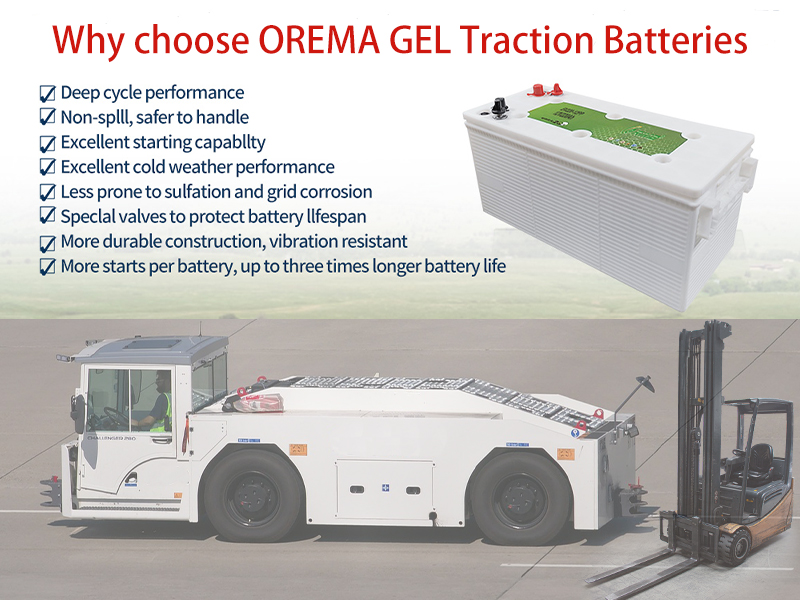
The Difference Between Traction Batteries and Ordinary Electric Vehicle Batteries
Ordinary Electric Vehicle batteries, such as those used in flashlights or remote controls, are designed for low - current, intermittent use. They are optimized to deliver a small amount of power over a long time or in short bursts. In contrast, traction batteries need to supply high - current pulses to start the vehicle's motor and then maintain a consistent current flow during operation. This high - current demand requires traction batteries to have a different internal construction. Traction batteries often have thicker plates and a more robust electrolyte system to handle the continuous charge - discharge cycles and high - current loads. Additionally, the capacity of traction batteries is much larger. For example, a typical AA alkaline battery might have a capacity of around 2000 - 3000 mAh, while a lead - acid traction battery for an electric forklift can have a capacity ranging from 100 Ah to over 1000 Ah. Another significant difference is the lifespan. Traction batteries are designed to endure hundreds or even thousands of charge - discharge cycles, while ordinary batteries may degrade after a relatively small number of uses.
Are Traction Batteries Deep Cycle Batteries?
Most traction batteries are deep - cycle batteries, but not all deep - cycle batteries are suitable for traction applications. Deep - cycle batteries are designed to be discharged to a significant depth (usually 50% - 80% of their capacity) and then recharged repeatedly. Traction batteries, in particular, need to be deep - cycle because vehicles and equipment operate until the battery is partially depleted. For example, an electric forklift might work for several hours until the battery's state of charge is low. A good traction battery should be able to handle these deep discharges without significant degradation. However, not all deep - cycle batteries are optimized for the high - current demands of traction applications. Some deep - cycle batteries are better suited for applications like off - grid energy storage, where the discharge current is lower and more constant. Traction batteries typically have a higher peak discharge rate capability to meet the sudden power needs of starting and accelerating a vehicle.
How to Choose a Lead - Acid Traction AGM Batteries for Your Electric Forklift?
When choosing a lead - acid traction battery for an electric forklift, several factors need to be considered. First, the capacity of the battery should match the usage requirements of the forklift. Calculate the average daily operating time, the weight the forklift typically carries, and the type of terrain it operates on. A larger, heavier - duty forklift that works for long hours in a demanding environment will need a motive power battery with a higher capacity. Second, the voltage of the battery must be compatible with the forklift's electrical system. Most electric forklifts operate on specific voltage levels, such as 24V, 36V, or 48V. Using a battery with the wrong voltage can damage the forklift's motor and other electrical components. Third, consider the battery's cycle life. A battery with a longer cycle life will save money in the long run as it will need to be replaced less frequently. Look for batteries from reputable manufacturers known for producing high - quality, long - lasting lead - acid traction batteries. Fourth, the charging time and charging requirements are important. Some lead - acid batteries can be charged quickly, while others require a more extended charging time. Also, make sure the charging equipment available is compatible with the chosen battery. Finally, cost is a factor, but it should not be the sole determinant. A slightly more expensive Motive Battery with better performance and a longer lifespan may be a more cost - effective choice in the long term.