

Despite not being the flashiest or most expensive component of a car, the battery's role in ensuring a smooth and uninterrupted driving experience cannot be overstated. It's the heart of your vehicle's electrical system, quietly working to keep everything running seamlessly. Yet, many drivers rarely consider their battery's health or understand the importance of its voltage level.
Voltage is a key aspect of any battery, from the one in your vehicle to the ones in your remote controls. Understanding the correct voltage measurements for your car battery is crucial to maintaining its health and ensuring your car runs properly. This guide aims to shed light on the often underestimated car battery, focusing on the significance of voltage and how it impacts your vehicle's operation. Let's dive into the essentials of car battery voltage and why it deserves your attention.
Car Battery Voltage Chart
During normal operation, car batteries are maintained above 12 volts, and using up to 50% of the battery's charge is generally acceptable without detrimental effects. However, when the voltage dips below 11.9 volts, the performance of the car's electrical system can deteriorate rapidly, given that it is designed to operate with a minimum of 12 volts.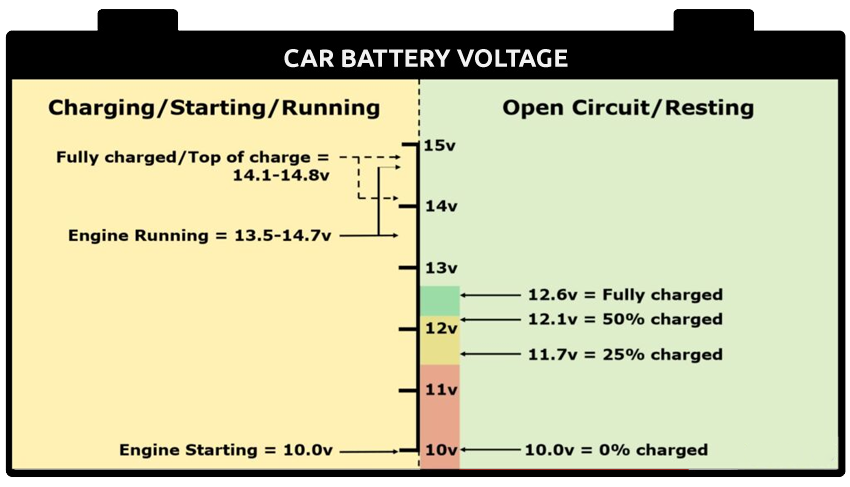
|
Voltage |
State of the Battery's Charge |
|
12.6 or higher |
100% |
|
12.5 |
90% |
|
12.42 |
80% |
|
12.32 |
70% |
|
12.2 |
60% |
|
12.06 |
50% |
|
11.9 |
40% |
|
11.75 |
30% |
|
11.58 |
20% |
|
11.31 |
10% |
|
10.5 or lower |
Dead |
What is normal voltage for an automotive battery?
A standard car battery, commonly referred to as a 12-volt battery, typically has a resting voltage slightly higher than its nominal value, around 12.6 volts when the vehicle is turned off. This resting voltage is crucial for gauging the battery's health and should ideally be measured after the car has been inactive overnight to ensure accuracy. When the engine runs, the battery's voltage rises to between 13.5 and 14.5 volts, thanks to the alternator, which not only powers the vehicle's electrical components like lights, stereo, and power windows but also recharges the battery for its next use.To accurately assess a car battery's condition, it's recommended to check its voltage under a resting state. If an immediate reading is necessary shortly after driving, letting the battery sit idle for at least an hour can still provide a relatively accurate measure, though ideally, an overnight rest is preferred to reach a true resting voltage. It's important to note that a well-maintained car battery's voltage can fluctuate based on various factors, including temperature, the length of time it has been stored, and its specific design. A healthy car battery should show a voltage between 12.6 to 12.9 volts in these conditions.
At what voltage is a car battery dead?
A car battery operates within a relatively narrow voltage range, signifying its charge level. A fully charged battery will show a voltage of about 12.7 volts or more, indicating good health and readiness to power your vehicle's electronics. On the other hand, a voltage reading below 12 volts suggests that the battery is only one-quarter charged and needs attention. A critical threshold is at 11.9 volts-below this, the battery is deemed dead, and it is highly unlikely your car will start. When the voltage drops to 10.8 volts or less, it's a clear sign the battery is nearly depleted, and the car's ability to start becomes questionable.The lifespan of lead-acid batteries, which are common in cars, significantly decreases if they are left discharged for extended periods. Modern vehicles, with their plethora of electronic features, require a robust power supply, making it vital to maintain battery health. Should you discover your battery`s voltage is alarmingly low after not using your car for a few days, it's essential to first eliminate potential parasitic drains like lights or the radio left on. If these are not the culprits, the issue might lie with the alternator, particularly if it's draining the battery due to a malfunction, such as failed diodes allowing current to flow in the reverse direction.
What is the lowest battery voltage to start a car?
To successfully start a car, the battery voltage plays a crucial role. Ideally, the battery should have a voltage of at least 11.8V for the car to start smoothly. Attempting to ignite the car with a voltage lower than this threshold might be challenging and requires turning off all other electrical devices to possibly conserve power for the start. However, if the battery's voltage drops below 10.8V, starting the car becomes significantly more difficult, and in most cases, it won't start at all. Under such circumstances, it's advisable to either replace the battery or use a car jump starter pack for an emergency ignition. While there might be instances where a car starts with a voltage as low as 10.8V, relying on such a low voltage is not recommended due to the inconsistency and potential damage to the vehicle's electrical system.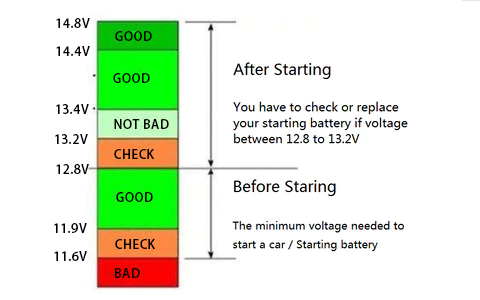
Battery voltage value judgment chart (for 12V cars)
|
|
Starting Battery Voltage |
Judgement |
Impacts and Solutions |
|
Before Start |
<10.8V |
Too LoW |
Cannot Start Vehicle.The battery may need tobe replaced |
|
Before Start |
10.8V-11.8V |
LOW |
Hard to Start, turn off allother electricalappliances and tryseveral times |
|
Before Start |
11.8V-12.8V |
Normal |
/ |
|
After Start |
12.8V-13.2V |
Too LOW |
May not be able torecharge the battery |
|
After Start |
13.2V-14.8V |
Normal |
/ |
|
After Start |
>14.8V |
Too High |
May damage the battery.check the enginestabilizer |
Why the voltage of a car battery is important?
The voltage of a car battery is a crucial indicator of the battery's condition and its ability to function properly. It is vital for ensuring that your vehicle runs smoothly and efficiently, as it not only supplies the electrical needs of the vehicle when the engine is not running but also kick-starts the engine by providing the necessary high current to the starter motor. Once the engine starts, the alternator takes over the supply of power to the car's electrical systems, while the battery stabilizes the voltage across these systems to prevent damage from voltage spikes.Understanding the significance of car battery voltage is essential because it affects the vehicle's performance. A battery with low voltage may lead to difficulties in starting the car and could impact the operation of electrical components like headlights, radio, and power windows. Conversely, a battery with excessively high voltage poses a risk to the vehicle's sensitive electronics by potentially overloading them.
Regular monitoring of your car battery's voltage can preempt issues, allowing for early intervention before a minor problem becomes a major inconvenience. This proactive approach can help avoid the unwelcome scenario of being stranded due to a dead battery, ensuring that your vehicle remains reliable and ready to use. Maintaining awareness of the battery's voltage is therefore not just about prolonging its life but is integral to the overall health and functionality of your car's electrical system.
Factors Affecting Car Battery Voltage
The voltage of a car battery, crucial for its performance and longevity, is influenced by several key factors, each playing a significant role in its efficiency and reliability. Understanding these elements can help in maintaining optimal battery health and prevent common automotive issues.Temperature and Environmental Conditions: Temperature extremes are the most significant factors affecting battery voltage. Cold temperatures reduce the battery's capacity, hindering its ability to start the vehicle, while hot weather can lead to the evaporation of battery fluid, damaging its internal structure. Additionally, environmental factors like atmospheric pressure and moisture also impact battery voltage, with harsh winter conditions being particularly detrimental.
Age and Usage: Over time and with continuous use, a battery's ability to hold a charge and its overall voltage output declines. This natural wear results from electrochemical reactions within the battery during charging and discharging, which can produce gases or insoluble substances, increasing internal resistance and lowering voltage.
State of Charge (SOC): The current charge level, or SOC, directly influences battery voltage. A fully charged battery should ideally measure above 12.6 volts. However, this can drop to around 12.2 volts at a 50% SOC and further decrease to as low as 11.8 volts when completely discharged.
Engine State and Load: Starting the engine requires significant power, causing a temporary voltage drop below 10 volts. Once running, the alternator boosts the voltage to between 13.7 and 14.7 volts. Moreover, the magnitude of the electrical load impacts the battery voltage. A high load can decrease the voltage and potentially damage the battery.
Overcharging and Undercharging: Proper charging is vital for maintaining battery voltage. Overcharging can cause electrolyte breakdown, reducing voltage capacity, while undercharging leads to sulfation and voltage decrease, emphasizing the importance of a balanced charging process.
External Factors: Dust, rust, and grime accumulation can alter the battery's internal chemistry, affecting its performance and potentially leading to voltage fluctuations, thereby stressing the need for regular maintenance to ensure clean and efficient battery connections.
FAQs about Car Battery Voltage
What is the voltage of a fully charged car battery?
A car battery, when fully charged, operates at a voltage of approximately 12.6 volts. This is due to the battery comprising six cells, with each cell contributing around 2.1 volts. When these cells are configured in series within the battery, the result is an increase in the overall voltage or power output, especially noticeable during the operation of your vehicle. It's essential for a fully charged battery to retain its rated capacity and not to lose its charge state unnecessarily.What is the voltage of the car when it starts?
When starting a car, the battery voltage is typically around 12.6 volts, but during the initial start-up phase, the voltage can drop to around 10 volts due to the high current draw required to crank the engine.What is the voltage of the car when it is running?
Turning on your vehicle's engine triggers a demand for current, which can vary due to environmental factors such as temperature and altitude. This necessitates a fluctuating voltage output from the alternator, adjusting daily to meet these needs. Typically, while a car is operational, its battery voltage ranges from 13.2 to 14.8 volts. A battery is considered fully charged at readings between 12.5 and 13 volts, and at 75% charge, it stands at 12.4 volts. A voltage reading of 11.5 volts signifies a fully discharged battery, indicating a dip into lower performance voltage levels. Both extremes in this voltage spectrum are critical for understanding the battery's efficiency and operational capacity.How to test the voltage of a car?
While a mechanic or a place that offers oil changes can check your car's voltage, you can easily perform this task at home. All that's required is a multimeter or a voltmeter, which are both easily obtainable and budget-friendly.Begin by ensuring the car is off and then proceed to uncover the positive terminal of the battery. At this juncture, it's wise to inspect the battery terminal for any signs of corrosion and clean it if necessary. Following this, connect the multimeter or voltmeter's positive lead to the battery's positive terminal, and the negative lead to the battery's negative terminal.
Next, turn the car's key to the run position without starting the engine, and observe the reading on your multimeter or voltmeter. This reading will indicate the vehicle's voltage level. Ideally, the voltage should be between 12.6 and 12.8, though it may vary slightly based on the temperature. If the voltage exceeds 12.8, it's advisable to use some of the car's electrical features to slightly deplete the battery before starting the car. Conversely, if the voltage falls below 12.6, it might be time to recharge the battery.
What Causes a Battery to Lose Voltage?
The core reason a battery experiences a reduction in voltage is attributed to both aging and usage. Unlike gasoline consumed by a car, voltage, representing electrical potential, does not deplete in the traditional sense during battery operation. Instead, the ongoing process of power production gradually alters the battery's chemical composition. The transformed chemicals possess a diminished capacity for power generation, leading to a gradual decline in the battery's voltage.Typically, lead-acid batteries have a service life ranging from three to five years, beyond which their voltage levels may not be sustainable. On the other hand, batteries designed with Enhanced Flooded Battery (EFB) or Absorbent Glass Mat (AGM) technology might enjoy a slightly extended lifespan, potentially adding an additional year or two before replacement becomes necessary.
Read More:
What Voltage Should a 12V AGM Battery Be?