

In the era of global industrial electrification and green transportation, motive battery has emerged as the indispensable backbone powering countless electric devices and vehicles. Unlike stationary batteries designed for backup power, motive batteries are professionally engineered to deliver sustained, stable driving power for mobile equipment, covering diverse scenarios from industrial handling machinery to commercial electric vehicles. To fully understand this critical power solution, it is essential to explore its core classifications and application scenarios, including semi traction battery, industrial battery, motive power battery, and professional Motive Power Electric Vehicle Battery systems.
First and foremost, it is vital to clarify the definition of a traction battery. A traction battery, also known as an electric vehicle battery, is a battery that powers an electric vehicle motor. The batteries are rechargeable and designed to provide power for long periods of time. They are commonly used in forklifts, electric golf carts, sweepers, electric motorcycles, electric cars, trucks, vans, and other electric vehicles. The traction battery has a long cycle life and can provide electricity for a long time, so that electric vehicles can maintain continuous power output during long hours of work. This core definition lays the foundation for all motive power battery applications, distinguishing it from ordinary consumer batteries that only support short-term, low-power output.
Motive power battery is the general term for all batteries that provide driving power for mobile equipment, with traction batteries being its most important branch. It focuses on high continuous discharge performance, excellent cycle stability, and strong adaptability to frequent start-stop and load fluctuation working conditions. Whether it is light daily mobile equipment or heavy industrial machinery, qualified motive power batteries can maintain stable power output, avoid sudden power failure or voltage drop, and ensure the safe and efficient operation of equipment. This is also the core reason why motive power batteries are widely adopted in modern industrial and transportation fields.
As a differentiated type, the semi traction battery fills the gap between full traction batteries and ordinary industrial batteries. Semi traction batteries balance performance and cost, featuring moderate cycle life and stable medium and low power continuous output. Different from full traction batteries that support long-term high-load operation, semi traction batteries are more suitable for light-duty, intermittent working scenarios. They are commonly applied in small electric sweepers, light-duty golf carts, miniature handling equipment, and low-frequency mobile industrial tools, providing reliable motive power while effectively reducing equipment operating costs, making them a cost-effective choice for lightweight motive scenarios.
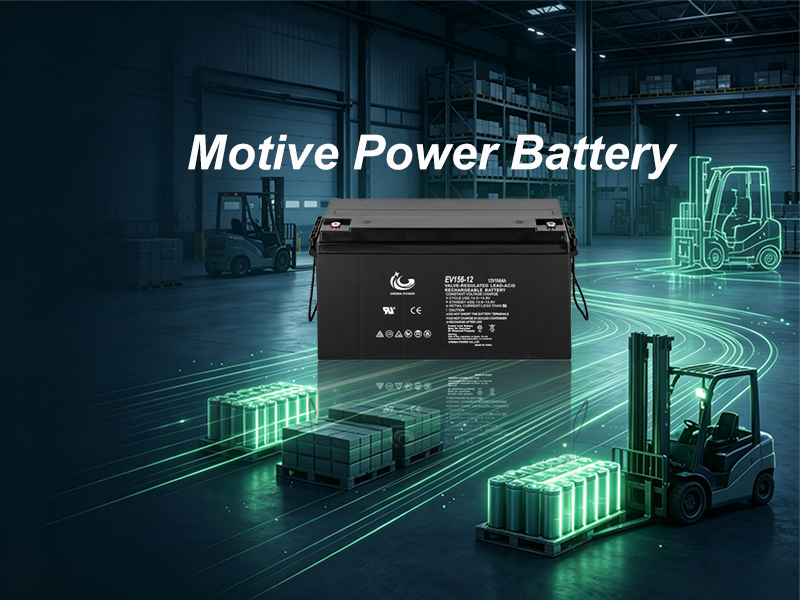
In industrial scenarios, industrial battery represented by industrial-grade motive and traction batteries undertakes heavy-duty power tasks. Industrial batteries are optimized for harsh working environments such as high-intensity continuous operation, temperature changes, and mechanical vibration in factories, warehouses, and ports. Compared with civilian batteries, industrial batteries have thicker internal structures, stronger anti-vibration and anti-impact capabilities, and longer service life under cyclic charging and discharging. Heavy-duty forklifts, port stackers, industrial cleaning sweepers, and aerial work platforms all rely on high-performance industrial batteries to support round-the-clock industrial operations, ensuring the continuity and efficiency of industrial production.
For professional transportation scenarios, Motive Power Electric Vehicle Battery is a specialized upgraded version of conventional traction batteries. Tailored for electric vehicles including electric cars, trucks, vans, and electric motorcycles, this type of battery focuses on higher energy density, safer discharge performance, and longer cycle life. It can adapt to complex road conditions, frequent acceleration and deceleration, and long-distance driving demands. While maintaining continuous power output, it optimizes battery heat dissipation and anti-aging performance, effectively extending the service life of electric vehicles and reducing maintenance costs. It is the core power guarantee for the popularization of new energy commercial and civilian electric vehicles.