

In our everyday lives, the unnoticed yet crucial force behind the ignition of our cars or the smooth sailing of boats is the humble battery. This key player in our daily transportation adventures comes in two main varieties: marine and car batteries. While they might initially appear to be similar, a closer look reveals significant differences tailored to their specific environments and applications.
Car batteries are engineered to meet the demands of land transportation. Their primary function is to start the vehicle's engine, ensuring a reliable and smooth operation. They are the backbone of cars and trucks, providing the necessary power for ignition and supporting the vehicle's electrical needs. In contrast, marine batteries are designed with the maritime environment in mind. They are built to withstand the rigors of sea conditions and go beyond merely starting engines. Marine batteries also supply energy to various boat equipment, making them indispensable for the operation of marine vessels.
What is a Car Battery?
A car battery, also known as an automotive battery, plays a pivotal role in the functionality of combustion engine vehicles. This rechargeable battery's primary task is to supply electrical power to start the vehicle's engine. Upon turning the ignition key, a signal is sent to the battery, prompting it to convert stored chemical energy into electrical energy. This surge of electricity is directed towards the starter, which, in turn, cranks the engine.Typically, a standard car battery in modern vehicles is a 12-volt lead-acid type, which is instrumental in initiating the electrical components of a car. Inside the battery, lead plates are submerged in sulfuric acid, triggering a chemical reaction that releases energy, thus providing the necessary voltage and current to start the engine. This process involves six multi-plate cells connected in series within a single enclosure, each cell contributing 2 volts to sum up to a 12 V output.
The design of car batteries, often referred to as starter batteries, incorporates a large number of thin lead plates. This structure is essential for producing a significant initial current required to start the vehicle. Unlike marine batteries, which are designed for longevity over repeated discharges, car batteries focus on delivering a powerful burst of energy. Besides starting the engine, they also play a crucial role in powering the car's electronic fuel injection system, ignition system, and other sensitive systems when the vehicle is in use.
While the engine runs, it generates energy that powers accessories such as wipers, lights, GPS, and stereo. However, when the engine is off, the car battery steps in to provide short-term power to these components. This aspect is particularly reflected in a battery's cold-cranking amps (CCA) rating, which indicates the amount of power the battery can offer to start the vehicle under cold temperature conditions.
What is a Marine Battery?
Marine batteries serve a critical role in the operation of boats, providing not just the necessary power to start the engine but also supporting a boat's various electrical needs. These batteries differ significantly from their automotive counterparts in several key areas, including their construction, function, and the demands placed upon them by the marine environment.Unlike car batteries, which are primarily designed to deliver a large initial current to start the engine, marine batteries are built to offer both an initial burst of energy and a sustained supply. This continuous power is essential for running the boat's electrical systems, such as lighting, sound systems, pumps, and navigational devices like GPS and fish finders. Consequently, for boats loaded with these maritime extras, opting for a full deep cycle battery is advisable. This choice contrasts with the more traditional hybrid deep cycle/starter batteries, ensuring that all electrical components are adequately powered.
Marine batteries are engineered to be more robust than car batteries. This enhanced durability is due to their thicker lead plates and a sturdier construction designed to withstand the rigors of marine travel. The vibrating and jostling associated with moving across water bodies demand a battery that can endure without succumbing to damage. This resilience is vital for preventing short-circuits and other malfunctions in choppy waters.
Both types of batteries, despite their differences, are lead-acid based and require careful handling, especially during recharging or replacement, to avoid electrical hazards. Regular checks of the batteries and their connectors are essential for safety and to maintain optimal performance.
A distinctive aspect of marine batteries is their rating system, which includes Marine Cranking Amps (MCA). This rating differs from the Cold Cranking Amps (CCA) used for car batteries, reflecting the different operational environments. Marine batteries are tested at the freezing point, considering boats are less likely to encounter icy conditions, unlike cars, which may need to start in temperatures below freezing.
Marine batteries are specialized power storage devices crafted to meet the unique demands of marine engines and electronics. With their capability to power high compression engines and withstand the environmental stresses of marine travel, they are indispensable for ensuring the smooth operation of both the vessel's engine and its electrical accessories.
Difference between Car Battery and Marine Battery
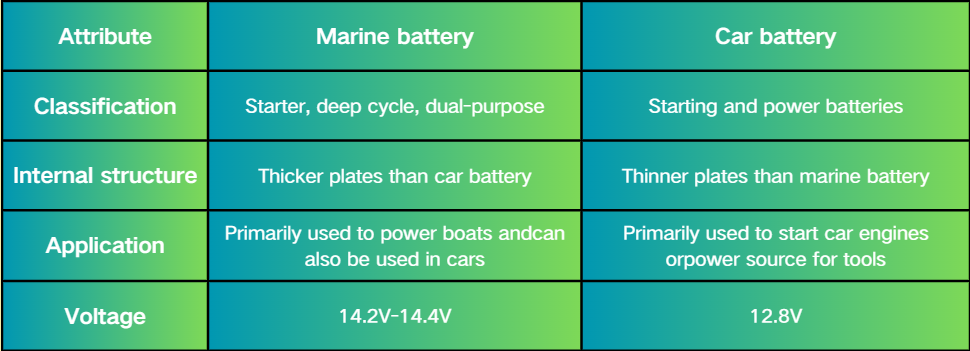
The distinction between marine batteries and car batteries lies in their design and functionality, catering to the unique demands of their respective environments. Marine batteries are built to withstand the rough conditions of the sea, with features tailored to ensure reliability and safety aboard a vessel. These batteries come equipped with sturdier, thicker plates, enabling them to endure the constant vibration and impacts from waves without short-circuiting or sustaining damage. This robust construction is essential for maintaining the battery`s integrity and preventing the loss of active materials, corrosion, electrolyte leaks, and ultimately, battery failure.
Unlike car batteries that deliver powerful, short bursts of energy primarily for starting the engine, marine batteries are designed for dual purposes. They not only possess the cranking power required to start high compression engines but also have the capacity to continuously power a boat`s various accessories like gauges, pumps, and lights over extended periods. This continuous power supply is crucial for the smooth operation of onboard systems, ensuring that everything runs seamlessly and efficiently.
In terms of construction, marine batteries differ significantly from car batteries. While car batteries feature a large number of thin, porous plates to minimize internal resistance and maximize active material exposure to the electrolyte, marine batteries, particularly deep cycle types, have fewer, but much thicker and denser plates. This design difference supports the marine battery`s ability to provide sustained energy output and resist the physical challenges presented by marine environments.
When it comes to ratings, car batteries are usually measured in Cranking Amps (CA) or Cold Cranking Amps (CCA), which indicate their ability to start an engine in cold conditions. Marine batteries, on the other hand, are rated in Marine Cranking Amps (MCA), reflecting their capacity to deliver a certain number of amps at 0 degrees Celsius for 30 seconds while maintaining a voltage of at least 1.2 volts per cell. This rating underscores the marine battery`s suitability for the maritime setting, where both starting power and endurance are paramount.
Durability and sturdiness are other critical factors that set marine batteries apart. Designed to handle the relentless pounding and vibration of sea travel, these batteries are more robust and durable than their automotive counterparts. This resilience is vital for ensuring the safety and longevity of marine journeys, making it imperative for boat owners to choose batteries specifically designed for marine use. The decision to invest in a marine battery, therefore, is not just about performance but also about ensuring the safety and reliability of marine vessels in all conditions.
Can a car battery be used to power a boat?
Using a car battery to power a boat is not advisable due to the distinct requirements and environments these batteries are designed for. While both types of batteries are based on lead-acid technology, their applications and designs significantly differ to cater to their specific use cases. Car batteries are engineered to deliver high bursts of power in short durations primarily for starting the engine. In contrast, marine batteries are built to provide a steady supply of power over extended periods, essential for the continuous operation of a boat.Furthermore, marine batteries are specifically tailored to thrive in the challenging conditions of a marine environment. They possess enhanced features for durability, including resistance to vibrations, water, and corrosion, which are common in marine settings. These adaptations are critical for ensuring reliable performance and safety on the water. Conversely, car batteries lack these necessary modifications, making them unsuitable for boat use. Employing a car battery in a marine setting can lead to numerous problems, such as quicker degradation, heightened risk of corrosion, and potential safety hazards, due to its inability to withstand the maritime conditions.
Read More:
What Should a Car Battery Voltage Be?
Choosing the Best Marine Battery for Trolling Motor
The ultimate guide on how to charge a car battery